Innovative Technology
(1) Material Innovation
In terms of sodium-ion battery materials, the research team innovatively introduced specific trace elements into layered oxides. By precisely controlling the atomic-level doping ratio, they enhanced the stability of the material's crystal structure, thereby reducing the structural changes of the electrode materials during charging and discharging, effectively minimizing capacity degradation and improving the cycle life of the battery. In the field of lithium solid-state ion batteries, a new type of high-nickel single-crystal ternary material was adopted. Compared to traditional polycrystalline materials, the single-crystal structure can better resist structural damage under high pressure, increasing energy density while enhancing the safety and cycle stability of the battery.
Deep learning models under real conditions of materials
During the search for breakthrough materials crucial to nanoelectronics and energy storage, we developed ZmartSim, a deep learning model that can accurately and effectively simulate and predict the performance of materials over a wide range of elements, temperatures, and pressures, thereby enabling material design. ZmartSim uses deep learning to understand the interactions between atoms, starting from the fundamental principles of quantum mechanics, spanning various elements and conditions - from 0 to 5000 Kelvin (K), from standard atmospheric pressure to 10 million atmospheres. In our experiments, ZmartSim effectively handles the simulations of various materials, including metals, oxides, sulfides, halides, and their various states, such as crystals, amorphous solids, and liquids. Moreover, it also provides customized options for complex prediction tasks by integrating the data provided by users.
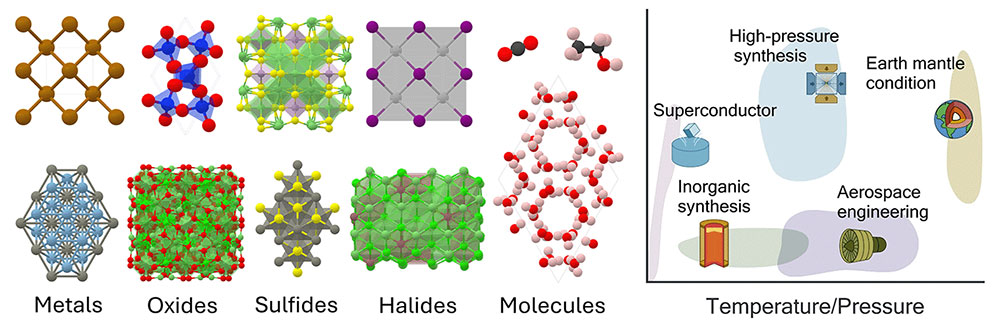
Simulate the materials under the actual conditions as they appear in the periodic table of elements.
The learning foundation of ZmartSim is based on large-scale synthetic data, which is generated through a combination of active learning, generative models, and molecular dynamics simulations. This data generation strategy ensures a wide coverage of the material space, enabling the model to predict energy, atomic forces, and stress. As a machine learning force field, its accuracy is consistent with first-principles predictions. Notably, compared with the previous state-of-the-art models, ZmartSim has improved the accuracy of material performance predictions under limited temperature and pressure by a factor of 10. Our research demonstrates its proficiency in simulating a wide range of material properties, including heat, mechanical, and transport properties, and even the prediction of phase diagrams.
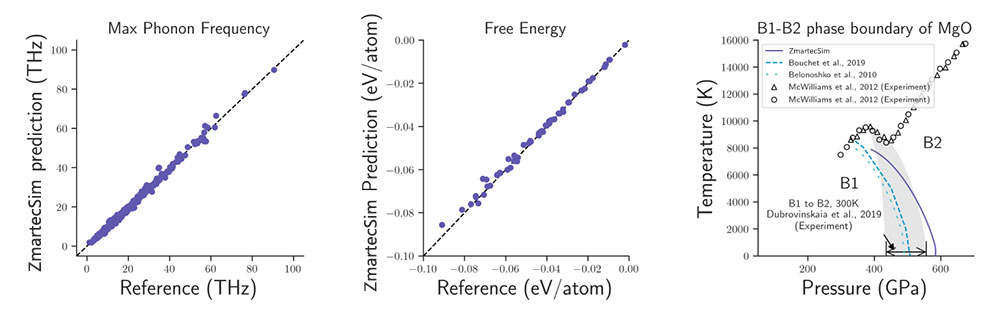
Adapt to complex design tasks
Although trained on a wide range of synthetic datasets, ZmartSim can also adapt to specific design requirements by merging additional data. This model utilizes active learning and fine-tuning to customize predictions with high data efficiency. For instance, simulating the properties of water - a seemingly simple but computationally intensive task - has been significantly optimized by ZmartSim's adaptive capabilities. Compared to traditional methods, this model requires only 3% of the data to achieve experimental accuracy, while specialized models require 30 times the resources and first-principles methods require exponential amounts of resources.
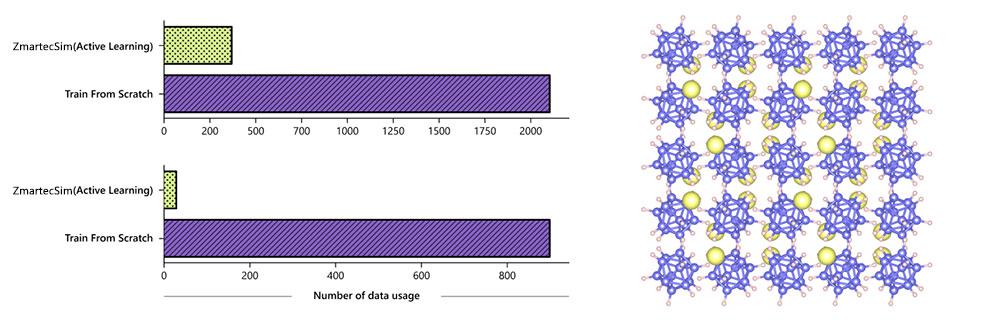
(2) Innovative Battery Structure Design
An integrated and modular battery system structure was designed, integrating battery cells, thermal management system, BMS system, etc. This approach reduces the connection components between components, lowers energy loss and fault points. At the same time, the internal space layout of the battery was optimized to increase the energy density and volume utilization rate of the battery pack, making the battery system more compact and efficient, and better suited to the space requirements of different vehicle models.
(3) Innovation in Battery Management System (BMS)
The independently developed intelligent BMS features real-time status monitoring and adaptive control capabilities. It collects parameters such as voltage, current, and temperature of the battery through high-precision sensors, and uses deep learning AI algorithms to predict the precise remaining capacity (SOC) and health status (SOH) of the battery, with the error controlled within an extremely small range. Moreover, it can dynamically adjust the charging and discharging strategies based on the real-time status of the battery and the operating conditions of the vehicle, achieving the maximum performance of the battery and the extension of its lifespan.